

Menu
ASTM A252 steel pipe pile provides a structural foundation member for transferring axial and lateral loads from bridges, marine structures, industrial facilities, and other heavy foundations into deeper soil or bearing strata. Produced in welded or seamless form, the cylindrical steel pile may remain as the permanent load-carrying element or serve as a shell for a cast-in-place concrete pile.
Unlike pressure pipe, selection of a steel pipe pile is driven mainly by pile diameter, wall thickness, grade, embedded length, drivability, soil conditions, structural loading, splice design, and corrosion exposure. During installation, the pile must withstand hammer or vibratory driving stresses before it begins carrying the long-term foundation load.
Enpro Pipe supplies ASTM A252 steel pipe piles in Grades 1, 2, and 3, with seamless and welded manufacturing options for different foundation designs and installation conditions. Available sizes extend to 48 in. outside diameter, with wall thickness, pile length, end preparation, and surface protection selected according to the required pile section and project specification.
| Supply Item | Enpro Pipe Range |
|---|---|
| Grades | ASTM A252 Grade 1, Grade 2, Grade 3 |
| Outside Diameter | Up to 48 in. |
| Manufacturing Types | Seamless, ERW, LSAW, SSAW, DSAW |
| Wall Options | STD, SCH 40, XS, SCH 80, XXS, SCH 160; project-specific wall thickness subject to size |
| Length | 6 m, 12 m, or project-specific fixed length |
| Ends | Plain end or beveled end |
| Surface / Coating Options | Bare/project finish, FBE, 3PE, galvanized where specified |
For steel piling projects, OD × wall thickness × length provides a clearer basis for specification than schedule alone. These dimensions determine the pile cross-section, unit weight, splice arrangement, transportation length, and resistance to handling and driving loads.
ASTM A252/A252M sets the material and acceptance requirements for cylindrical welded and seamless steel pipe piles used as permanent foundation members or as steel shells for cast-in-place concrete piles. The specification covers three strength grades—Grade 1, Grade 2, and Grade 3—and controls the properties that directly affect pile fabrication and acceptance, including mechanical strength, elongation, dimensions, weight, workmanship, testing, and product marking.
| Standard Item | ASTM A252 Requirement |
|---|---|
| Current Standard | ASTM A252/A252M-26 |
| Pile Type | Cylindrical steel pipe pile |
| Grades | Grade 1, Grade 2, Grade 3 |
| Construction | Welded or seamless |
| Weld Seam Options | Longitudinal or helical seam, depending on manufacturing process |
| Typical Structural Use | Permanent load-bearing pile or shell for cast-in-place concrete pile |
| Main Acceptance Controls | Mechanical properties, elongation, dimensions, weight, workmanship, testing, and marking |
Both seamless and welded production routes are permitted, so the manufacturing method can be matched to the required diameter, wall thickness, pile length, and project fabrication plan. For welded piles, seam quality and dimensional consistency remain important because the finished section must withstand handling, splicing, and installation loads before it begins carrying the foundation load.
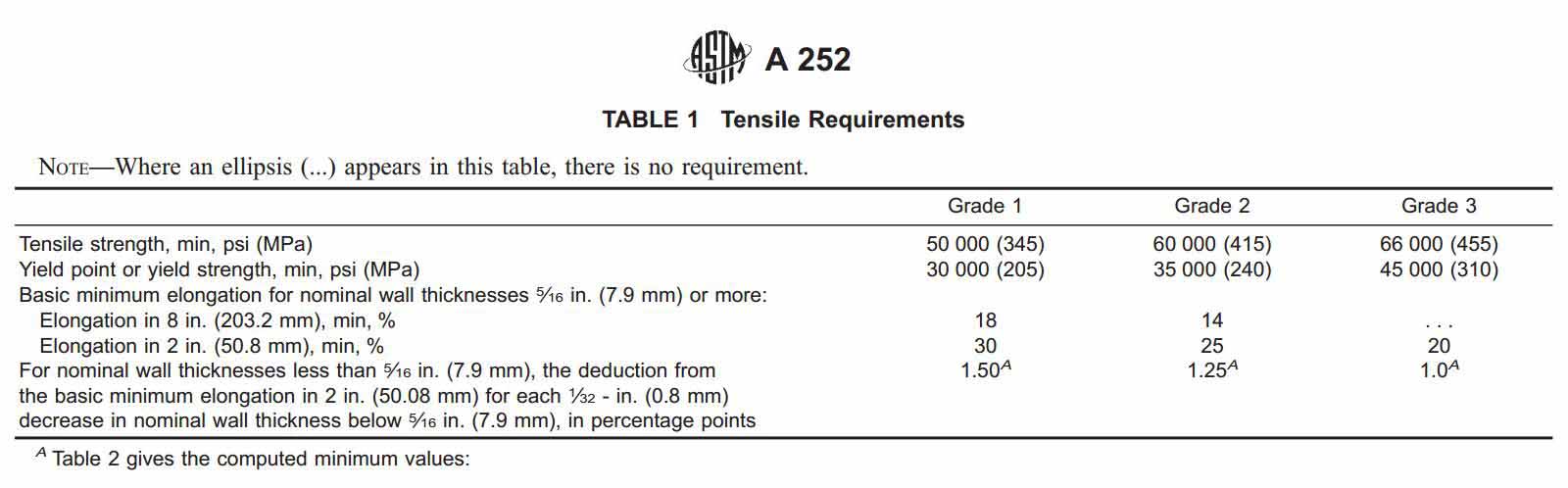
The three ASTM A252 grades are distinguished mainly by their minimum tensile and yield strengths. In actual foundation design, the selected grade works together with pile diameter, wall thickness, unsupported length, anticipated driving stress, soil resistance, corrosion allowance, and design load to determine the required pile section.
| Mechanical Property | Grade 1 | Grade 2 | Grade 3 |
|---|---|---|---|
| Minimum Tensile Strength | 50,000 psi / 345 MPa | 60,000 psi / 415 MPa | 66,000 psi / 455 MPa |
| Minimum Yield Strength | 30,000 psi / 205 MPa | 35,000 psi / 240 MPa | 45,000 psi / 310 MPa |
| Basic Min. Elongation in 2 in. / 50.8 mm* | 30% | 25% | 20% |
For nominal wall thickness of 5/16 in. [7.9 mm] or more; thinner wall sections use the reduction provisions specified by ASTM A252.
ASTM A252 Grade 3 pipe is commonly specified for steel piling where a higher-strength section is required, with a minimum tensile strength of 455 MPa (66,000 psi) and minimum yield strength of 310 MPa (45,000 psi). Grade 3 can be supplied in seamless or welded form, while welded construction is more common for the larger diameters frequently used in foundation piling. Its higher strength supports demanding pile sections, while the final wall thickness and section size still depend on driving energy, soil resistance, pile length, corrosion allowance, and structural load.
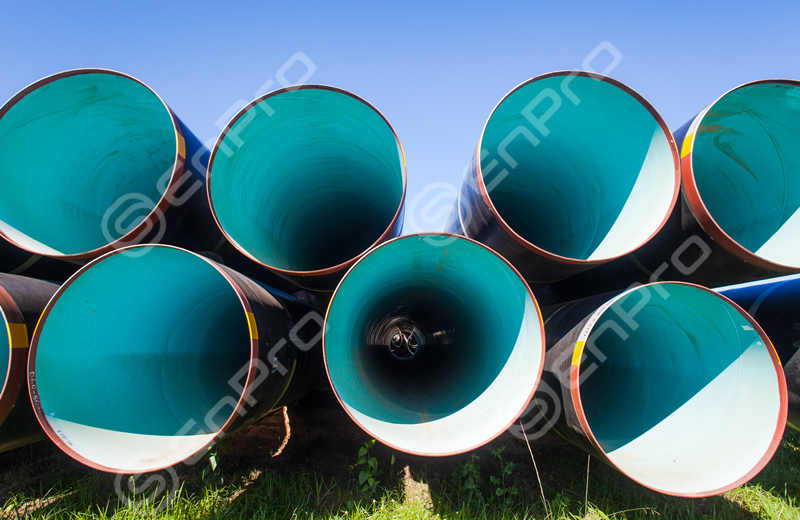
ASTM A252 pipe piles are produced by seamless or welded processes according to the required diameter and wall thickness. For welded piles, steel plate or coil is formed into a cylindrical shell, welded with a longitudinal or helical seam, then sized, straightened, cut to length, and prepared at the ends for shipment or field splicing. ASTM A252 permits seamless, electric-resistance-welded, flash-welded, and fusion-welded construction.
Quality inspection focuses on the dimensions and mechanical properties that directly affect pile fit-up, driving, and structural performance:
Hydrostatic testing is not a standard ASTM A252 acceptance requirement, since the product is specified as structural piling rather than pressure pipe. Additional NDT of longitudinal or spiral welds can still be added through the project specification or ITP when required.
ASTM A252 allows a limit of phosphorous maximum at 0.050%, This is because P will make steel more fragile and break, further more higher P is not good for welding processes.
ASTM A252 steel pipe piles are used where shallow foundations cannot provide the required support or where large axial and lateral loads must be transferred through weak surface soils into deeper strata.
Corrosion protection should be selected from the actual exposure environment, especially for piles passing through seawater, tidal zones, aggressive soils, or continuously wet ground. The ASTM A252 designation itself does not establish a project corrosion life.
Depending on the design, protection may include additional corrosion allowance, FBE or multilayer coating systems, galvanizing for suitable applications, cathodic protection, or a combination of these measures. Coating selection should also consider pile driving because the pile surface can experience abrasion and impact while passing through soil.
For marine projects, the designer should define the required protected zone, coating specification, design corrosion allowance, inspection method, and repair procedure before the pile is manufactured.
At Enpro Pipe, we focus first on matching the pile to the project rather than treating every ASTM A252 inquiry as the same product. Grade, OD, wall thickness, pile length, manufacturing route, splice arrangement, end preparation, coating, quantity, and inspection requirements are the details that determine whether the material can move smoothly from fabrication to pile driving.
Our current ASTM A252 supply range includes Grades 1, 2 and 3, seamless and welded construction, sizes up to 48 in., 6 m / 12 m or project lengths, and several surface-protection options. For project orders, we also pay attention to material identification, dimensional records, packing, and shipping documentation so that piles can be checked against the PO before installation begins.


Q1: What is the difference between ASTM A252 pipe pile and API 5L pipe?
A1: ASTM A252 covers cylindrical steel pipe piles used as foundation members or concrete-pile shells, while API 5L covers seamless and welded line pipe for oil, gas, and other energy-product transportation. Matching OD and wall thickness alone does not make the two specifications interchangeable.
Q2: Does ASTM A252 specify the load capacity of a steel pipe pile?
A2: No fixed pile capacity is assigned by ASTM A252. The standard controls the steel pipe pile product and material requirements; actual axial and lateral capacity depends on pile geometry, embedment, soil conditions, installation method, and the foundation design.
Q3: Does ASTM A252 include corrosion coating requirements for pipe piles?
A3: ASTM A252 defines the steel pipe pile itself. Protective coatings are specified separately according to the exposure environment; for example, ASTM A972/A972M covers fusion-bonded epoxy coatings for pipe piles.
Q4: Can ASTM A252 pipe be substituted for ASTM A500 structural tubing?
A4: Direct substitution requires design approval. ASTM A252 is written for cylindrical piling, while ASTM A500 covers cold-formed round, square, rectangular, and special-shape structural tubing used in buildings, bridges, and general structural construction. Their intended applications and acceptance requirements are different.
Q5: What should be specified for field-spliced ASTM A252 pipe piles?
A5: The project documents should define the pile section length, splice detail, end preparation, alignment, welding procedure, welder qualification, and required weld inspection. These details affect site fit-up and load transfer through the splice and are normally controlled by the foundation and welding specification rather than the ASTM A252 material designation alone.