

Menu
ASTM A335 pipe covers seamless ferritic alloy-steel pipe for high-temperature service, with P5, P9, P11, P22 and P91 among the commonly specified grades for boiler, power-generation, refinery and high-temperature process piping. The chromium-molybdenum alloy system varies by grade, giving each material a different combination of high-temperature strength, oxidation resistance, heat-treatment response and fabrication characteristics. The pipe is suitable for bending, flanging, similar forming operations and fusion welding when the applicable fabrication and welding procedures are followed.
Grade selection depends on the actual design temperature, pressure, wall thickness and long-term service conditions. P11 and P22 are widely used in conventional Cr-Mo high-temperature piping, while P91 uses a higher chromium level together with Mo, V, Nb and N and requires tighter heat-treatment and hardness control. Matching alloy piping components are commonly specified under ASTM A234 for fittings, such as WP11, WP22 and WP91, and ASTM A182 for forged flanges and fittings, such as F11, F22 and F91.
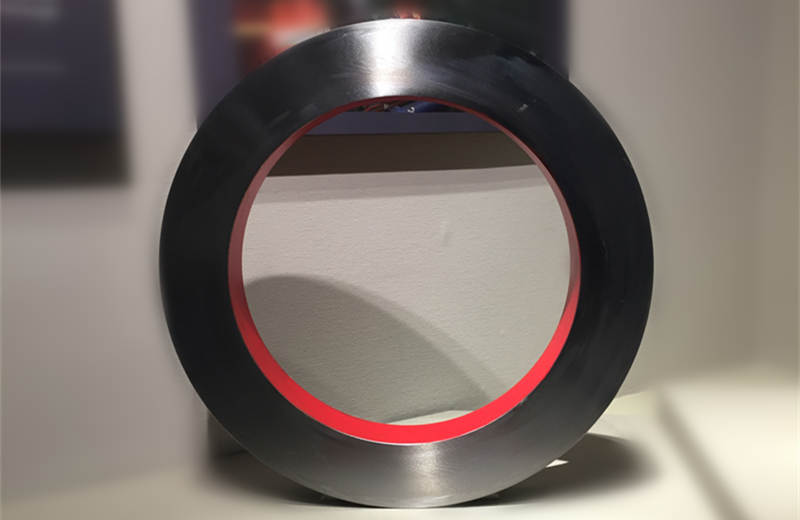
Enpro Pipe supplies A335 grades P5, P9, P11, P22 and P91 in seamless hot-finished or cold-drawn forms. The current product range covers sizes from 1/2 in. to 24 in., common high-temperature piping schedules and fixed or project-specific lengths.
| Supply Item | Enpro Pipe Range |
|---|---|
| Standard | ASTM A335 / A335M |
| Grades | P5, P9, P11, P22, P91 |
| Material | Ferritic Cr-Mo alloy steel |
| Manufacturing | Seamless, hot-finished or cold-drawn |
| Size Range | 1/2 in. to 24 in. |
| Wall Options | STD, SCH 40, XS, SCH 80, SCH 160, subject to size |
| Length | 6 m, 12 m or specified project length |
| Ends | Plain or beveled according to order requirements |
For alloy pipe, the material requirement is normally defined by a combination of NPS, schedule, grade, manufacturing condition, wall basis, length, end preparation, and documentation. A complete RFQ usually states the required grade, hot-finished or cold-drawn condition where relevant, nominal or minimum wall basis, length, end preparation, test documentation, and any supplementary project requirements.
ASTM A335/A335M applies to nominal-wall and minimum-wall seamless ferritic alloy-steel pipe for high-temperature service. The standard controls chemical composition, tensile properties, hardness where applicable, manufacturing condition and product testing. Each pipe is subject to hydrostatic testing and nondestructive examination under the applicable standard requirements.
| Specification Item | ASTM A335 Requirement |
|---|---|
| Current Standard | ASTM A335/A335M-26 |
| Product Type | Seamless ferritic alloy-steel pipe |
| Service | High-temperature piping |
| Typical Grades | P5, P9, P11, P22, P91 |
| Manufacturing | Seamless, hot-finished or cold-drawn as ordered |
| Fabrication | Suitable for bending, flanging, forming and fusion welding |
| Main Material Controls | Chemical composition, tensile properties, hardness where applicable |
| Product Testing | Hydrostatic test, NDE, tension test, flattening test, hardness or bend test as applicable |
ASTM A335 covers ferritic alloy steels containing up to 10% chromium, with each grade developed around a specific alloy balance and high-temperature performance level. Grade selection is based on the actual design temperature, pressure, mechanical properties, and long-term thermal behavior, while the allowable operating range is determined together with the applicable piping design code and service conditions.
The main difference between A335 grades starts with alloy composition. Chromium and molybdenum levels change considerably from one grade to another, which changes heat-treatment response and high-temperature material behavior.
| Grade | Carbon % | Chromium % | Molybdenum % | Main Alloy Character |
|---|---|---|---|---|
| P5 | ≤0.15 | 4.00–6.00 | 0.45–0.65 | 5Cr-Mo system |
| P9 | ≤0.15 | 8.00–10.00 | 0.90–1.10 | 9Cr-Mo system |
| P11 | 0.05–0.15 | 1.00–1.50 | 0.44–0.65 | 1.25Cr-0.5Mo |
| P22 | 0.05–0.15 | 1.90–2.60 | 0.87–1.13 | 2.25Cr-1Mo |
| P91 | 0.08–0.12 | 8.00–9.50 | 0.85–1.05 | 9Cr-1Mo with V, Nb and N |
For P91, the chemistry also includes V 0.18–0.25%, N 0.030–0.070% and Nb/Cb 0.06–0.10%, together with limits on Ni, Al, Ti and Zr. These elements form part of the controlled alloy system used to develop the material condition required for high-temperature service.
| Grade | Minimum Yield Strength | Minimum Tensile Strength |
|---|---|---|
| P5 | 205 MPa / 30 ksi | 415 MPa / 60 ksi |
| P9 | 205 MPa / 30 ksi | 415 MPa / 60 ksi |
| P11 | 205 MPa / 30 ksi | 415 MPa / 60 ksi |
| P22 | 205 MPa / 30 ksi | 415 MPa / 60 ksi |
| P91 | 415 MPa / 60 ksi | 585 MPa / 85 ksi |
P91 has a much higher room-temperature strength requirement than P11 or P22, but its engineering value is tied closely to the alloy system, final heat treatment and microstructure. Grade comparison therefore extends beyond the tensile table.
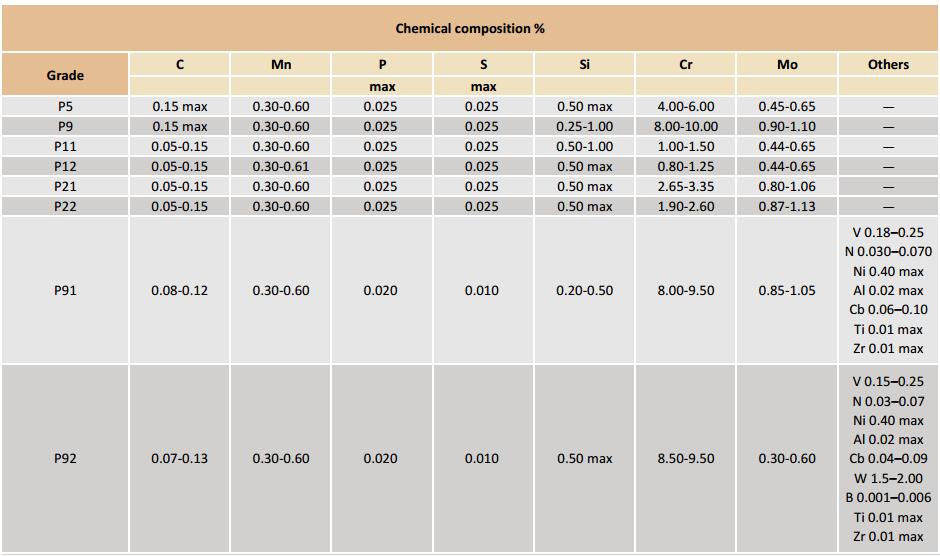
The chemical composition of ASTM A335 grades changes significantly with the required high-temperature performance. P5 and P9 use higher chromium contents, P11 and P22 are conventional Cr-Mo grades, while P91 and P92 add controlled amounts of V, Nb/Cb, N and other microalloying elements to support the heat-treated microstructure and long-term strength required in more demanding service.
P11 contains approximately 1–1.5% chromium and 0.44–0.65% molybdenum. It is used in Cr-Mo piping where elevated-temperature strength and weldable alloy-steel construction are required without moving into the higher-alloy P22 or P91 systems.
P22 increases chromium to 1.90–2.60% and molybdenum to 0.87–1.13%. This 2.25Cr-1Mo chemistry gives P22 a different high-temperature material response and makes it a common material for boiler, steam and hot process piping specified around this alloy class.
P91 contains 8.00–9.50% chromium, 0.85–1.05% molybdenum and controlled additions of V, Nb and N. Its minimum tensile and yield strengths rise to 585 MPa and 415 MPa, respectively. P91 fabrication also requires closer control of heat treatment, hardness and welding history because the final properties depend strongly on maintaining the intended metallurgical condition.
The selected ASTM A335 grade is matched to the actual service conditions, including design temperature, pressure, required wall thickness, allowable stress, thermal cycling, and the fabrication route used for the piping system.
P91 deserves separate attention because its high-temperature performance depends strongly on the condition created during heat treatment. Changes in heating, cooling or subsequent welding cycles can alter hardness and the microstructure developed in the material.
For P91 Type 1 and Type 2, the technical data used for this product range specifies a hardness range of 190–250 HBW, with equivalent limits of 196–265 HV or 91 HRBW to 25 HRC.
For a P91 order, the MTC and inspection package need to keep the heat number, chemistry, heat-treatment condition, tensile results and hardness results connected to the delivered pipe. Fabrication procedures—particularly welding and subsequent thermal treatment—also need to preserve the material condition assumed by the piping design.
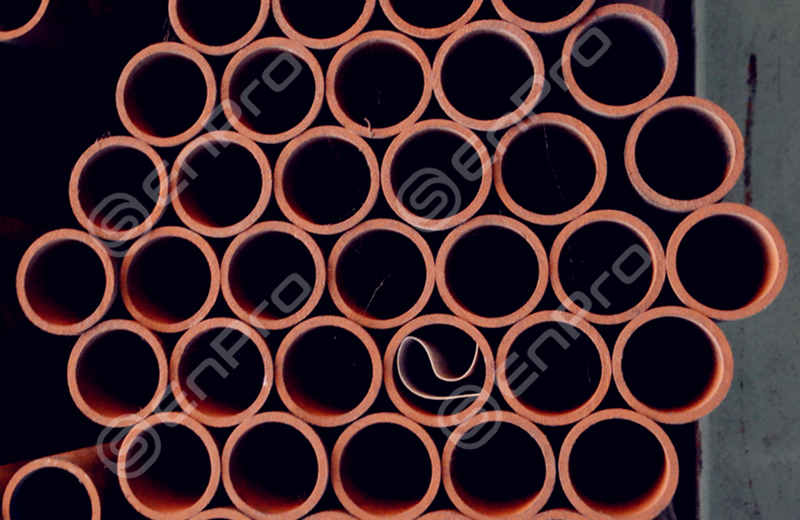
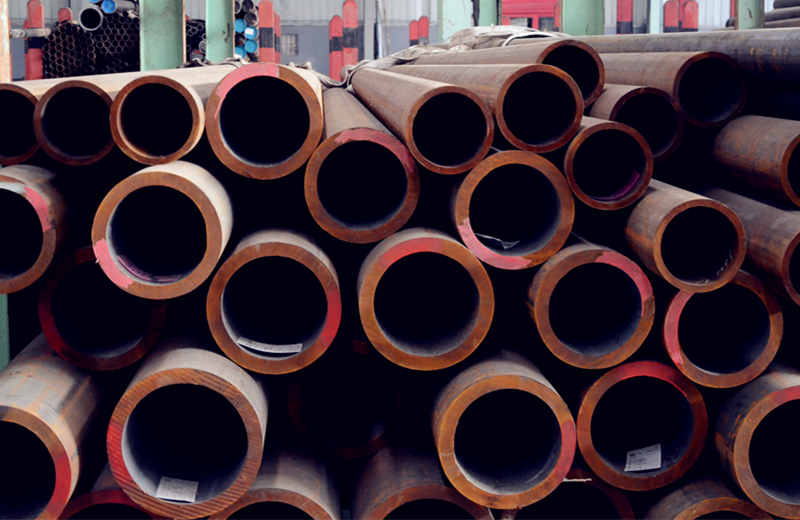
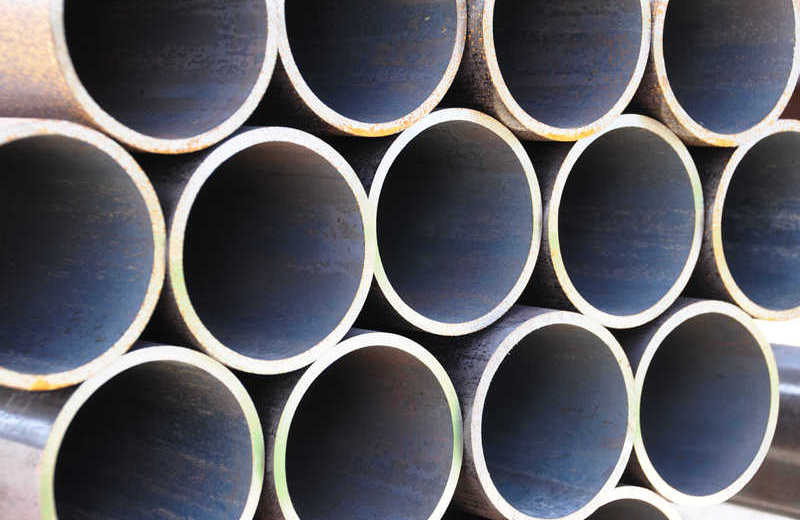
ASTM A335 pipe is produced by a seamless manufacturing route, starting from alloy-steel billets selected to match the required P grade. The billet is heated and pierced to form a hollow shell, then rolled and sized to the required outside diameter and wall thickness. Depending on the ordered condition, the pipe may be supplied hot-finished or undergo additional cold drawing before final thermal treatment.
Heat treatment is a key part of A335 production because the alloy system changes from grade to grade. P11 and P22 are conventional Cr-Mo steels, while P91 contains higher chromium together with Mo, V, Nb and N, so its final properties depend more closely on controlled thermal processing. After heat treatment, the pipe is straightened, sized, cut to length, and prepared at the ends before final inspection and marking. ASTM A335 covers seamless pipe only; any welding mentioned in the specification relates to subsequent fabrication of the finished pipe, not to the pipe manufacturing process itself.
Billet → Heating → Piercing → Rolling → Sizing → Heat Treatment → Straightening → Cutting → End Preparation → Final Release
ASTM A335 alloy pipe is specified for high-temperature piping exposed to sustained heat, pressure, and thermal cycling, where Cr-Mo alloy grades such as P11, P22, and P91 provide the material properties required for long-term service.
The operating limit of a finished system comes from the applicable design code and selected grade. ASTM A335 itself does not assign one common maximum service temperature to P5, P11, P22 and P91.
At Enpro Pipe, ASTM A335 alloy pipe orders are coordinated by grade, size, wall thickness, manufacturing condition, length, and end preparation. Our supply range covers P5, P9, P11, P22 and P91 from 1/2 in. to 24 in., with common schedules and 6 m, 12 m or project-specific lengths. Mixed-grade orders are separated by heat number and marking to reduce material mix-up during receiving and fabrication.
Quality control follows the requirements that matter for high-temperature alloy piping. Chemical composition and tensile properties are verified by grade; P91 orders also require close control of heat treatment and hardness. Hydrostatic testing, applicable NDE, dimensional inspection, and material traceability are checked before release. The pipe marking, heat number, MTC and test records are kept consistent so the delivered material can be identified and verified against the PO more easily.
Q1: What is the difference between ASTM A335 and ASME SA-335 pipe?
A1: ASTM A335 is the ASTM material specification, while SA-335 is the corresponding ASME BPVC material specification used in Section II. For code projects, the PO and material certificate should use the designation required by the governing construction code.
Q2: What is the difference between ASTM A335 pipe and ASTM A213 tube?
A2: ASTM A335 covers seamless ferritic alloy-steel pipe for high-temperature service. ASTM A213 covers seamless ferritic and austenitic boiler, superheater, and heat-exchanger tubes, with tube-specific dimensional and testing requirements. Similar alloy designations do not make the two product standards interchangeable.
Q3: Should PMI be specified for ASTM A335 P11, P22, or P91 pipe?
A3: PMI is valuable on mixed-alloy projects because it verifies that the actual alloy composition matches the specified material. API RP 578 specifically uses positive material identification within material-verification programs; the required PMI extent and reporting should be defined in the PO or ITP when applicable.
Q4: Can ASTM A335 P91 directly replace P22 or P11 pipe?
A4: A grade change requires engineering review. P11, P22, and P91 have different alloy chemistry, strength, heat-treatment response, and high-temperature characteristics, so changing grade can affect the piping design and fabrication requirements. ASTM itself states that material selection depends on design and service conditions.
Q5: Should ASTM A335 pipe be ordered by nominal wall or minimum wall thickness?
A5: ASTM A335 covers both nominal-wall and minimum-wall seamless pipe. The required wall basis should be stated clearly in the purchase specification, especially for engineered high-temperature piping where minimum remaining wall is part of the design requirement.