

Menu
API 5L pipe is manufactured for pipeline transportation systems where the pipe grade, wall thickness, manufacturing route, product specification level and service condition are defined as part of the complete line-pipe specification. API Spec 5L covers seamless and welded steel line pipe and establishes requirements for materials, manufacturing, inspection, testing, marking and traceability.
These requirements work together in the finished pipe. Grade and PSL define the required material and mechanical-property framework, while the manufacturing route determines whether the pipe is produced seamless or with an HFW or submerged-arc-welded seam. Outside diameter and wall thickness establish the basic pipe geometry, and project conditions such as low-temperature operation, sour service or additional toughness requirements can introduce further controls on testing and acceptance.
Enpro supplies API 5L line pipe from Grade B through X80 in PSL1 and PSL2 configurations, covering seamless, HFW and SAW production routes for different pipeline sizes and operating conditions. Production, inspection, pipe-end preparation and optional coating requirements are coordinated against the project specification so that the delivered pipe remains consistent with the required pipeline configuration.
API 5L specifies requirements for seamless and welded steel line pipe used in pipeline transportation systems for the petroleum and natural gas industries. It covers material, manufacturing, dimensional, testing, inspection and marking requirements for PSL1 and PSL2 products. API 5L applies to steel line pipe and does not cover cast pipe.
| Specification Item | Available Configuration |
|---|---|
| Product | API 5L Line Pipe |
| Grades | Grade B, X42, X46, X52, X56, X60, X65, X70, X80 |
| Product Specification Level | PSL1 / PSL2 |
| Manufacturing | Seamless, HFW/ERW, LSAW, SSAW/HSAW and applicable SAW configurations |
| Current Enpro OD Range | 1/2 in. through 40 in., subject to manufacturing route |
| Wall Thickness | SCH 10 through SCH 160, STD, XS, XXS and project-specified actual wall thickness |
| Ends | Plain ends / beveled ends |
| Typical Length | Approx. 20 ft / 6 m, 40 ft / 12 m or project-specified |
| Service | Conventional pipeline service, sour service and project-specific requirements |
| Surface / Protection | Bare, varnished or painted; external coating and lining systems available separately where specified |
For pipeline purchasing, actual OD and specified wall thickness should be confirmed even when a schedule designation is shown. A description such as “12 in. SCH 40” may be convenient for commercial reference, but pipeline design, mill production and receiving inspection are ultimately based on defined dimensional requirements.
External systems such as FBE, 3LPE or 3LPP should also be specified separately from the base API 5L pipe requirement because coating design, surface preparation, application and inspection are controlled by the applicable coating specification rather than by the API 5L grade designation itself.
For PSL2 line pipe, the suffix in the complete grade designation carries technical information and should not be dropped during purchasing or document review.
Suffixes such as N, Q and M identify the applicable delivery condition. Where a special service designation applies, that requirement also forms part of the complete ordered grade and service specification.
The base strength grade may be the same, but the complete designation tells the manufacturer and inspector how the material was produced and delivered. When replacement pipe is purchased for an existing pipeline, the original grade, PSL and delivery-condition suffix should therefore be checked from the MTC or approved pipe data sheet rather than reconstructed from field markings alone.
For sour-service orders, the service requirement should also be stated explicitly. The 47th Edition includes updated sour-service and sulfide stress cracking requirements, reinforcing the need to treat sour service as a defined technical condition rather than simply a commercial description.
API 5L pipe specifications are built around the actual pipeline requirement, not the grade name alone. Two pipes may both be marked API 5L X65 PSL2, but they can still differ in outside diameter, specified wall thickness, manufacturing route, delivery condition, impact requirements and service qualification. These differences affect how the pipe is produced, inspected and released for the project.
For a large-diameter transmission line, for example, the purchase description may call for X65M PSL2 LSAW pipe with a defined OD and wall thickness, beveled ends and project-specific inspection requirements. The M delivery-condition suffix, PSL2 designation and LSAW manufacturing route should remain consistent across the PO, mill certificate and pipe marking. If sour service, low-temperature toughness or additional NDE is required, those conditions also need to appear clearly in the purchasing specification rather than being assumed from the X65 grade itself.
This becomes particularly important when matching replacement pipe or reviewing material from more than one mill. A pipe with the correct nominal grade can still be unsuitable if the wall thickness, delivery condition, manufacturing process or inspection basis differs from the original line. For this reason, Enpro reviews the complete pipe configuration against the project specification before material is released, so the delivered pipe can be checked against the same technical requirements during receiving inspection and site installation.
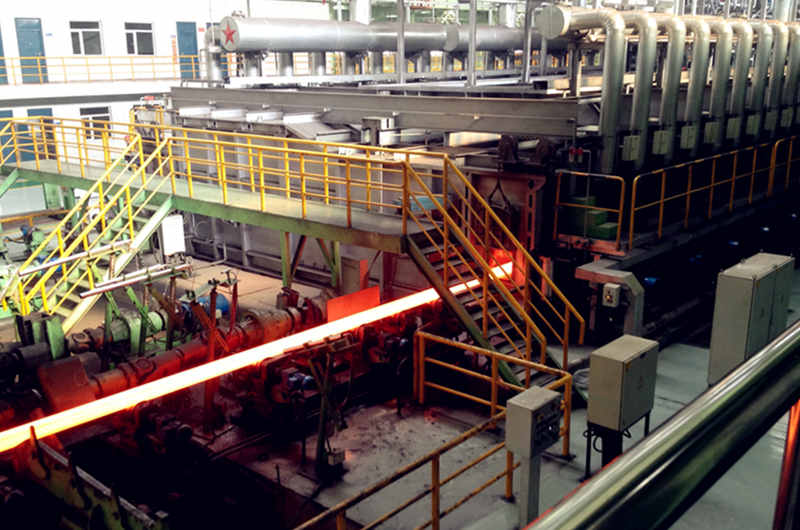
API 5L line pipe can be produced by seamless or welded manufacturing routes. The choice is normally driven by the required outside diameter, wall thickness, steel grade, production volume and project specification, rather than by assuming that one process is universally better than another. API 5L recognizes both seamless and welded line pipe and applies manufacturing, inspection, testing and traceability requirements according to the applicable product configuration.
| Manufacturing Type | How the Pipe Is Produced | Typical Selection Considerations |
|---|---|---|
| SMLS – Seamless | Pipe body is formed without a longitudinal weld seam | OD and heavy-wall availability, grade, dimensional tolerance and project requirements |
| HFW / ERW | Strip is continuously formed and the longitudinal edges are joined by high-frequency electrical heating and pressure | Weld-line quality, heat treatment where applicable, weld NDE and dimensional consistency |
| LSAW / SAWL | Plate is formed into pipe and joined with a longitudinal submerged-arc-welded seam | Large OD, heavier wall, high-strength grades and transmission pipeline projects |
| HSAW / SSAW / SAWH | Coil or strip is formed helically and joined by a spiral submerged-arc-welded seam | Large-diameter production, wall range, project acceptance and weld inspection requirements |
Seamless API 5L pipe has no longitudinal weld seam, but that does not mean it should automatically be specified for every pipeline. Its practical use depends on whether the required grade, OD and wall thickness fall within the selected mill’s seamless production range. For heavy-wall or replacement orders, those three values should be checked together instead of relying on a general statement such as “seamless available up to a certain diameter.”
HFW line pipe is produced from continuously formed strip with a longitudinal weld. For procurement, the important issue is not simply whether the quotation says “ERW,” but how the weld seam has been produced, heat treated where required, inspected and documented. Weld-line quality is significant enough that API specifically included additional HFW-related requirements in the latest API 5L revision.
LSAW pipe is commonly selected when a project requires a combination of large diameter, heavier wall thickness and higher-strength line-pipe grades that suits plate-forming production. The longitudinal seam becomes an important part of the inspection package, so receiving inspection should connect the finished pipe identification with the applicable weld NDE, mechanical-test results and hydrostatic-test record.
HSAW or SSAW pipe uses a helical welded seam and is frequently used where coil-based production suits the required large-diameter line-pipe program. API documentation uses the term SAWH for spiral/helical submerged-arc-welded pipe and distinguishes it from longitudinal SAWL production.
For these pipes, buyers should pay particular attention to the specified OD and wall thickness, forming geometry, weld inspection scope, pipe-end condition and traceability of the finished joint. Whether HSAW is acceptable is ultimately determined by the pipeline specification and project requirements, not by diameter alone.
PSL1 and PSL2 define different levels of technical requirements within API 5L. They should not be treated simply as standard quality and higher quality. For the same base grade, PSL2 generally applies tighter or additional controls to areas such as chemical composition, mechanical-property limits, manufacturing conditions, testing and traceability, depending on the grade and service requirement.
This difference becomes important when the pipe is ordered for a transmission line or used to replace material already in service. An API 5L X52 PSL1 pipe and an X52 PSL2 pipe may share the same base strength grade, but they are not automatically interchangeable because the applicable chemistry limits, strength ranges, test requirements and production records can differ. The required PSL should therefore remain consistent across the purchase order, MTC, pipe marking and inspection documents.
Chemical composition for PSL 1 pipe with t ≤ 25.0 mm (0.984 in)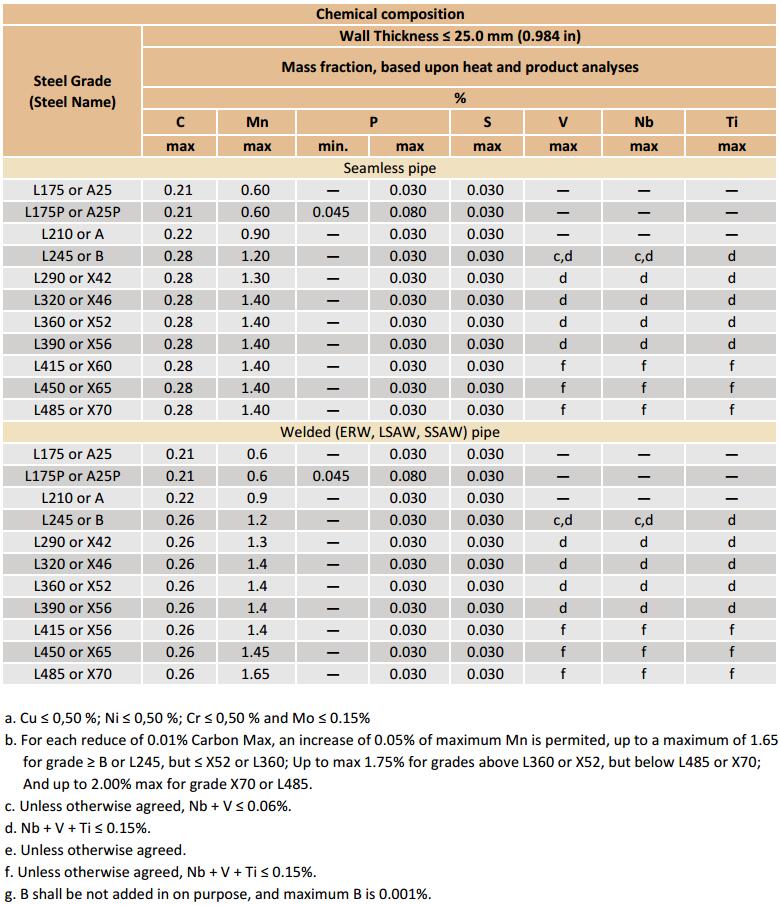
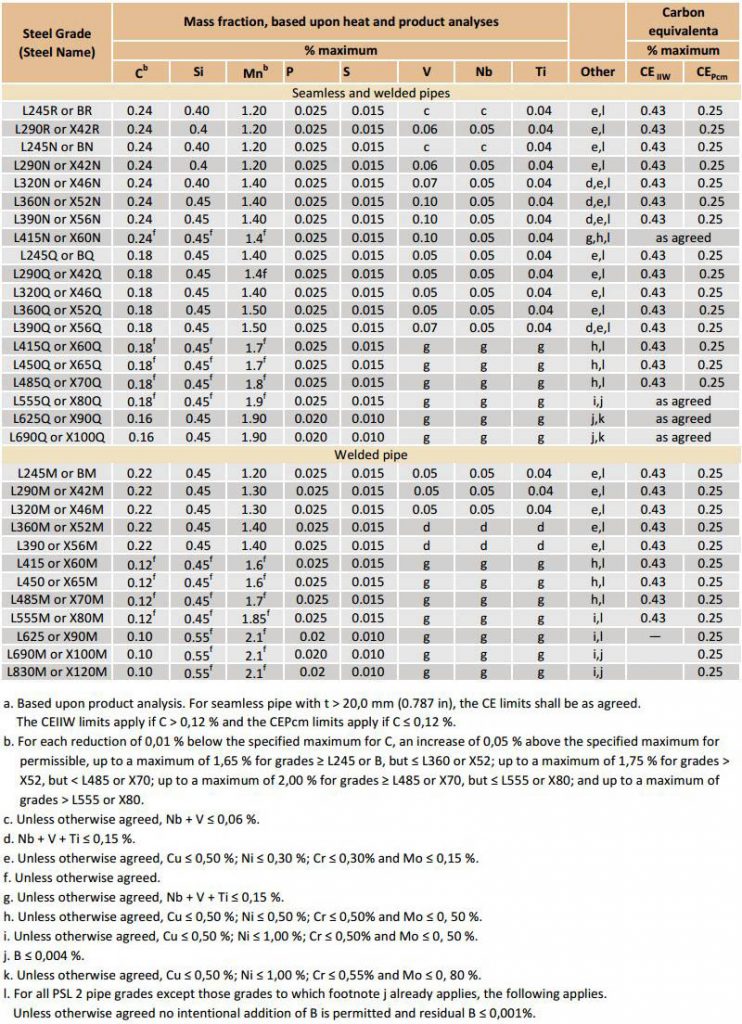
Yield Strength and Tensile Strength for API 5L PSL1
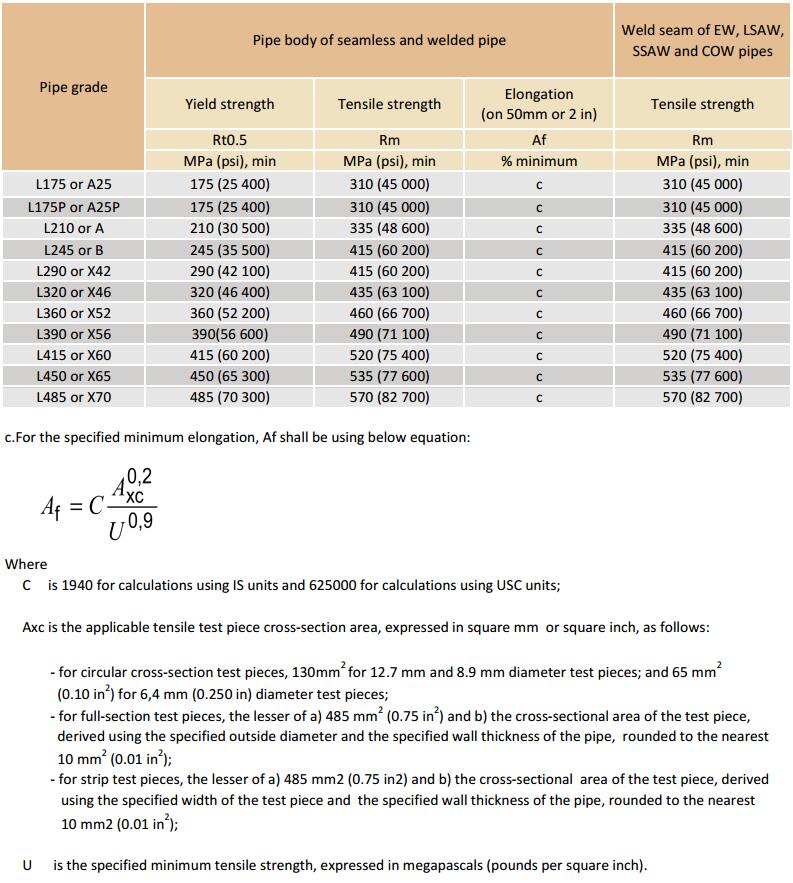 For PSL2 pipe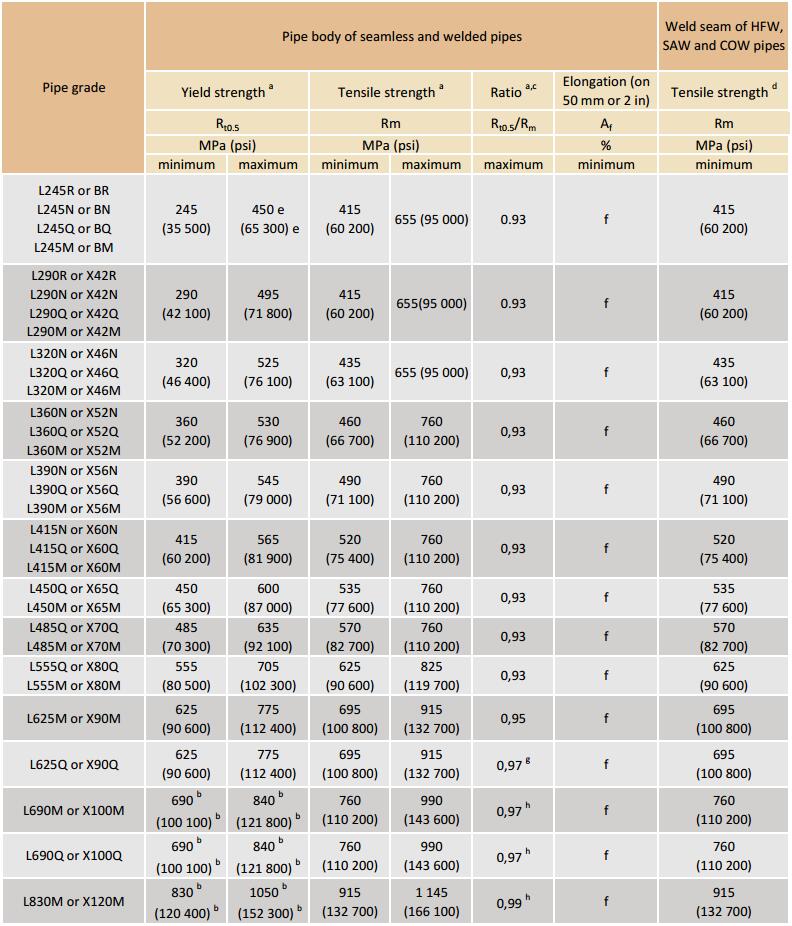
Inspection of API 5L pipe follows the manufacturing route, PSL, grade and service requirement of the order. A PSL2 HFW line pipe, for example, has a different inspection focus from a conventional PSL1 seamless pipe: the former requires particular attention to the longitudinal weld and its associated records, while sour-service material can introduce additional hardness, toughness or cracking-resistance requirements.
Before release, the pipe is checked against the ordered OD, specified wall thickness, length, straightness and pipe-end condition. Mechanical test results are then linked to the represented heat or production lot, while welded pipe also requires the applicable inspection of the weld seam and heat-affected area. API Spec 5L covers manufacturing, inspection, testing, marking and traceability, and its current requirements specifically address areas including NDE qualification, impact toughness, lamination control, HFW weld quality and hydrostatic-test control.
| Inspection / Test | What Is Checked | Procurement Significance |
|---|---|---|
| Dimensional Inspection | OD, wall thickness, length, straightness and pipe-end geometry | Confirms the delivered pipe matches the ordered dimensions and field fit-up requirements |
| Visual Inspection | Pipe body, ends and visible surface condition | Identifies handling damage and unacceptable manufacturing surface conditions before release |
| Tensile Test | Yield strength, tensile strength and applicable elongation requirements | Confirms the production lot meets the mechanical requirements of the ordered grade and PSL |
| Hydrostatic Test | Pressure integrity of the finished pipe and welded seam where applicable | Provides a production-stage pressure-integrity check before shipment |
| Nondestructive Examination | Pipe body and/or weld seam according to manufacturing route and specification | Detects relevant internal or surface discontinuities without damaging the finished pipe |
| Impact Test | Material toughness where required by grade, PSL, temperature or project specification | Important where resistance to brittle fracture is part of the pipeline design basis |
| Bend / Flattening Test | Ductility and weld behavior for applicable pipe configurations | Evaluates whether the material or welded region can tolerate specified deformation without unacceptable failure |
| Hardness / Sour-Service Testing | Hardness and additional service-related properties where specified | Relevant to sour-service and other projects with supplementary material requirements |
| Marking and Traceability Check | Grade, PSL, heat/lot identity and pipe marking against production documents | Connects the physical pipe to its MTC and inspection records |

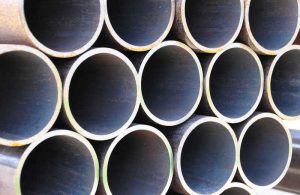
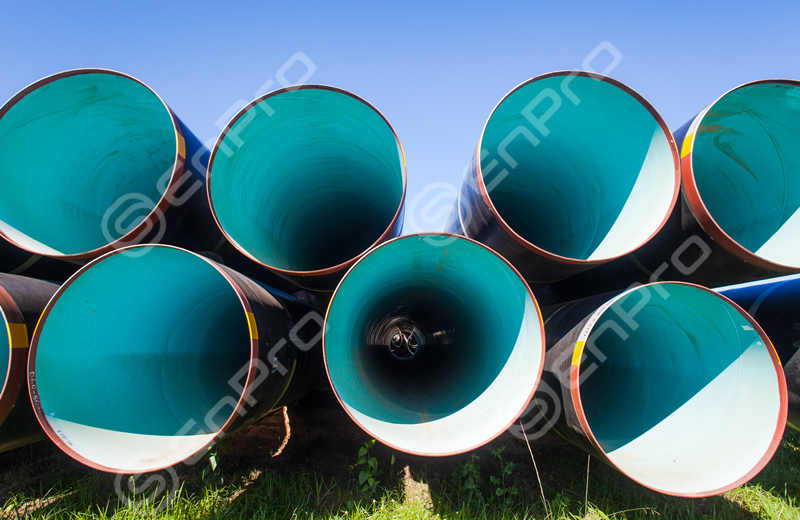
Enpro controls API 5L pipe orders from technical specification review through production, inspection and final shipment. Before production begins, the grade, PSL, manufacturing process, dimensions, delivery condition and project-specific requirements are checked against the approved specification, reducing discrepancies that otherwise appear only during document review or site receiving.
Production and inspection are followed by heat and lot identification, with mechanical-test results, applicable NDE, hydrostatic-test records and dimensional inspection kept traceable to the delivered pipe. For projects requiring beveled ends, FBE, 3LPE, 3LPP or other surface protection, these requirements can be coordinated with the base pipe so that pipe condition, end preparation and documentation remain consistent at delivery.
Enpro also supports repeat and replacement requirements where consistency with previously supplied material is important. Existing MTCs, pipe markings and project specifications can be reviewed against the new production requirement, helping maintain continuity in grade, dimensions and technical acceptance when additional API 5L pipe is required.
A1: Not automatically. A higher-strength grade is not a direct substitute unless the pipeline design, wall thickness, delivery condition, toughness, weld procedure and adjoining components are reviewed. Grade substitution should be approved against the original design and project specification.
A2: No. PSL2 alone does not establish sour-service suitability. Sour-service pipe requires the applicable API 5L service requirements and project-defined controls for material properties, testing and cracking resistance. The latest API 5L revision also includes updated sour-service and sulfide stress cracking requirements.
A3: Check the manufacturer’s API Monogram license status and licensed product scope in the API Composite List, then verify that the product marking and documentation correspond to that license. API states that only licensed manufacturers are authorized to apply the API Monogram to conforming products within their licensed scope.
A4: No. API 5L is a line-pipe specification for pipeline transportation systems, while ASTM A106 covers seamless carbon steel pipe for high-temperature service. Even when dimensions or strength appear similar, substitution requires engineering review of material, mechanical properties, testing and the applicable piping or pipeline design requirements.
A5: The base pipe specification and coating requirement should be defined separately. In addition to grade, PSL, OD and wall thickness, the order should state the coating system, applicable coating standard, required thickness, pipe-end cutback and inspection requirements so that the finished pipe is suitable for welding and field installation.