

Menu
OCTG casing and tubing pipe forms the pressure-containing tubular system used through well construction, completion, and production. Casing creates the structural and isolation barriers around the wellbore, while production tubing provides the controlled flow path between the completion interval and the wellhead. Both components may experience combinations of external collapse pressure, internal pressure, axial tension or compression, bending, temperature change, and connection loads during their service life. API describes casing and tubing as primary and secondary containment barriers that keep hydrocarbons and other fluids within the intended flow path.
Casing and tubing occupy different positions in the well and therefore face different design priorities.
| Item | Casing Pipe | Tubing Pipe |
|---|---|---|
| Position in Well | Installed around the wellbore and generally cemented in place | Installed inside the production casing |
| Primary Function | Wellbore support, pressure containment and zonal isolation | Production or injection flow path |
| Typical Loads | Collapse, burst/internal pressure, tension, compression and bending | Internal pressure, annulus pressure, tension/compression, thermal movement and connection loads |
| Typical Well Sections | Surface, intermediate and production casing strings | Completion and production string |
| Common API Connections | STC/LTC round thread, BTC, project-specific or premium connection | NUE, EUE, integral or premium connection |
| Installation | Run during well construction; many strings are cemented | Run during completion and can be retrieved or replaced during workover depending on well design |
A surface or intermediate casing string may spend much of its life resisting external formation or cement pressure, whereas production casing must also contain well pressure and support completion loads. Tubing works inside this casing envelope and carries produced or injected fluid through the well. Their selection is based on the complete downhole load case, combining diameter, wall thickness, grade, connection performance, pressure, and service environment.
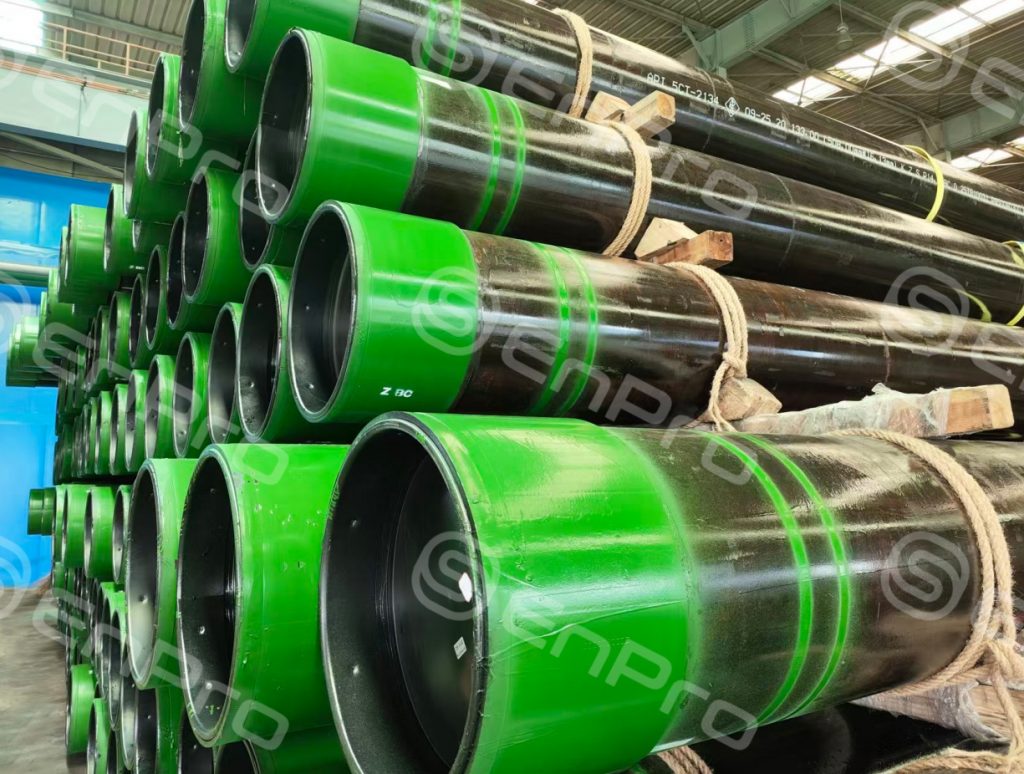
Enpro Pipe supplies API 5CT casing and tubing for well construction, completion, and production requirements. The current range covers casing from 5 1/2 in. to 20 in. and tubing up to 4 1/2 in., with commonly specified grades, length ranges, and API or premium connection options available for different well programs.
| Supply Item | Enpro Pipe Range |
|---|---|
| Casing Size | 5 1/2 in. to 20 in. |
| Typical Casing Length | R3 |
| Tubing Size | 1.0, 1.315, 1.66, 1.9, 2.063, 2 3/8, 3 1/2 and 4 1/2 in. |
| Typical Tubing Length | R2 |
| Grades | J55/K55, N80-1, N80Q, L80, C90, T95, P110, Q125 and 13Cr options |
| Casing Connections | BTC, LTC and premium connections |
| Tubing Connections | NUE, EUE and premium connections |
| Project Options | Couplings, end protection, marking and project-specific documentation |
For each order, the grade, pipe size, wall or weight, length range, connection and coupling configuration are matched to the well program. Drift requirements, heat-treatment condition, corrosion or SSC requirements, and inspection documentation can then be confirmed as part of the same material specification.
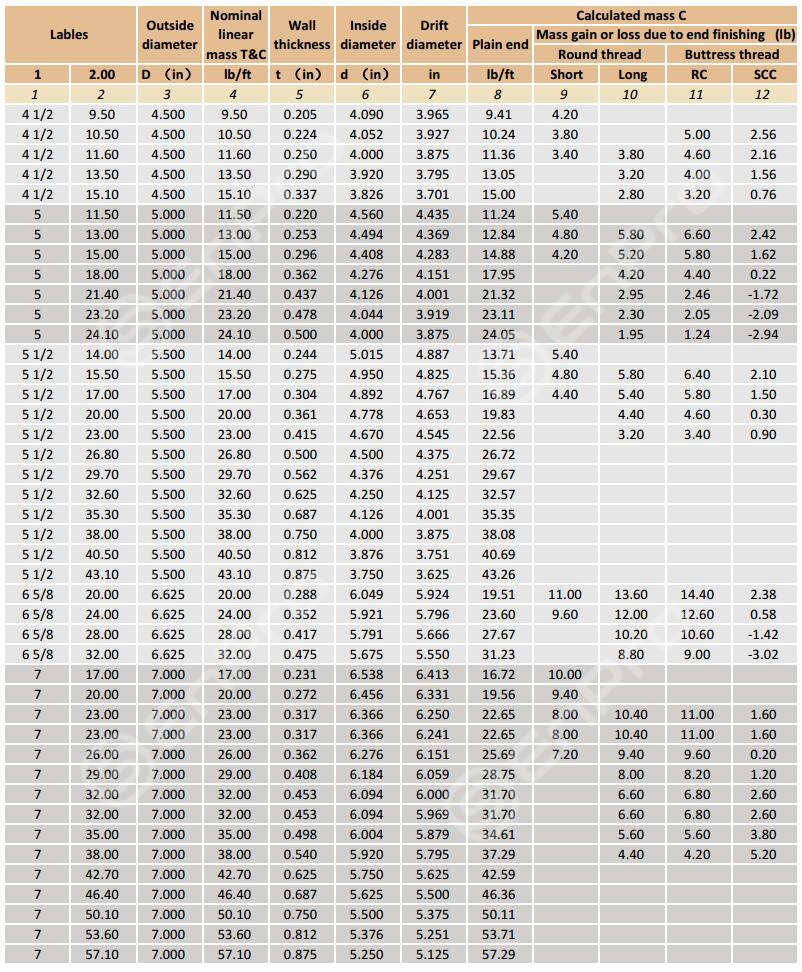
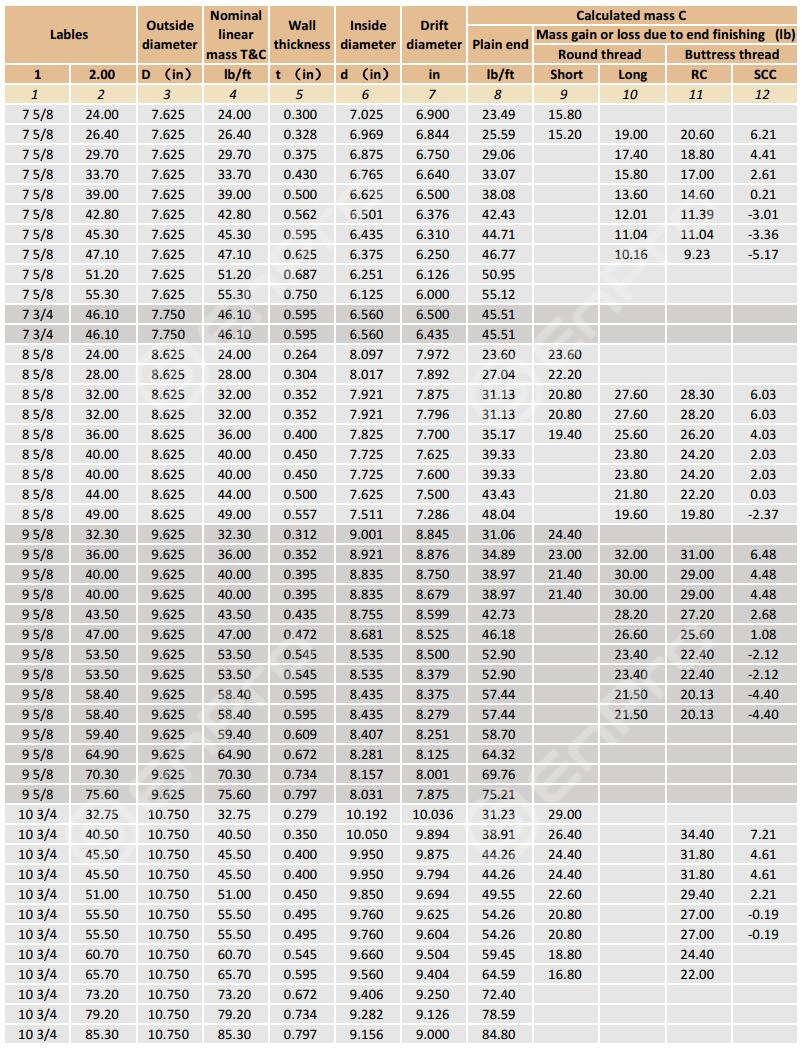
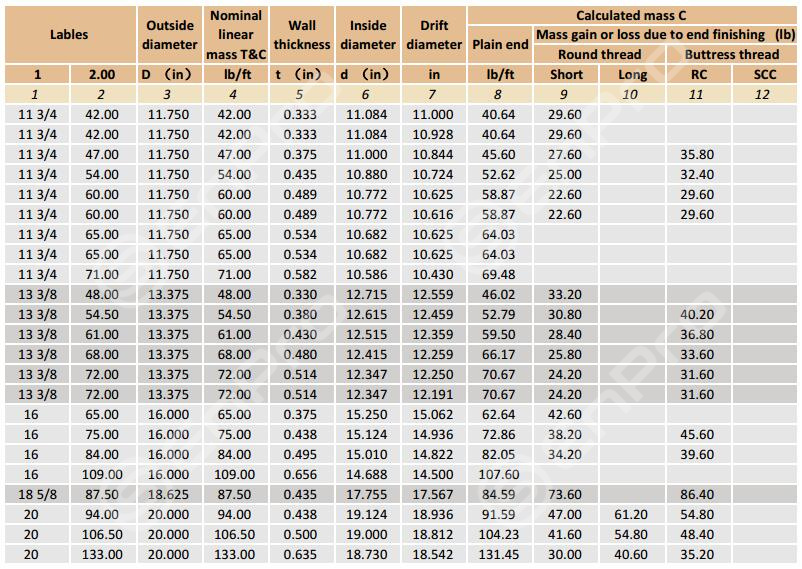

The connection is part of the load path and pressure barrier, so connection selection deserves the same attention as the pipe body.API Spec 5B controls thread dimensions, tolerances, gauges and inspection methods for API casing and tubing threads.
| Connection | Product | Construction |
|---|---|---|
| STC / Short Round | Casing | Short round-thread casing connection |
| LTC / Long Round | Casing | Longer round-thread casing connection |
| BTC / Buttress | Casing | Buttress thread profile |
| NUE / NU | Tubing | Non-upset tubing connection |
| EUE / EU | Tubing | External-upset tubing end and coupling |
| Premium / Proprietary | Casing or Tubing | Project-specific seal and structural design |
Premium connections are particularly relevant where the well requires enhanced gas sealing or combined-load performance. API RP 5C5 evaluates threaded connections for galling tendency, sealing performance and structural integrity under combinations of internal/external pressure, tension/compression, bending and temperature variation.
For proprietary connections, geometry, make-up procedure, seal design and qualification basis need to match the actual project requirement. A connection should not be described as an automatic replacement for another proprietary design solely because the nominal size and thread concept appear similar.
OCTG design involves several load modes acting at the same time.
ISO/TR 10400 provides the calculation basis for evaluating casing and tubing under axial load, internal pressure, and external collapse pressure. These calculated resistance values are then used together with the actual well loads and the design factors specified for the project.
In a casing string, pipe-body strength is only one part of the load assessment. A P110 casing may have sufficient axial and pressure capacity, while wall thickness, collapse resistance, or connection performance may become the controlling factor for the selected string configuration.
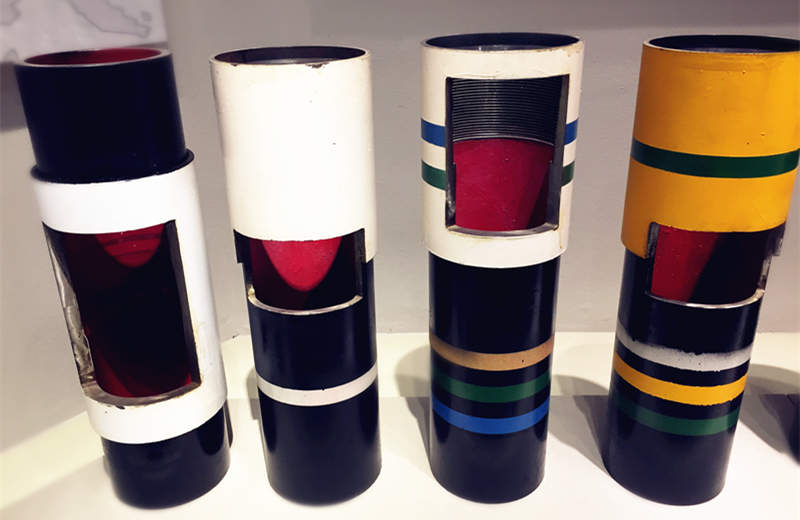
Grade selection starts with the loads and environment expected in the actual well. Minimum yield strength remains one part of the specification, but collapse resistance, burst resistance, axial load, heat-treatment condition, connection performance, temperature and corrosion environment also influence the final material.
J55 and K55 are common OCTG grades with the same nominal minimum yield-strength level of 55 ksi, but their material and application requirements are not identical. They are frequently encountered in conventional casing and tubing programs where the required pressure and axial loads remain within the selected pipe body’s performance envelope.
API recognizes both N80 Type 1 and N80Q. N80Q receives quench-and-temper processing, while the grade designation and heat-treatment route must remain clear on the material documentation because they affect the delivered metallurgical condition. Current API 5CT applies N80 requirements to both types when “N80” is used without further qualification.
L80 includes several material types—Type 1, 3Cr, 9Cr and 13Cr—so the PO needs to identify the actual material rather than simply state “L80.” C90 and T95 also receive additional attention where sulfide stress cracking performance forms part of the ordered requirements. API 5CT Addendum 1 specifically contains SSC test provisions for C90 and T95.
P110 and Q125 are higher-strength OCTG grades used where the casing or tubing design requires increased body strength. Their use still depends on the complete load case: a higher yield grade does not by itself establish the correct wall thickness, collapse rating, connection capacity or sour-service suitability.
C125 was introduced into API 5CT through Addendum 1, with specific requirements covering tensile properties, hardness, SSC testing, and thread surface treatment. Its use is normally evaluated together with the well load, sour-service condition, connection design, and project inspection requirements.
API 5CT casing and tubing may be produced by seamless or electric-welded routes, depending on the grade and product condition. Seamless OCTG starts with billet heating and piercing, followed by rolling and sizing to establish the required OD and wall thickness before straightening and further finishing.
Heat treatment varies by grade and directly affects the final strength, hardness, toughness, and metallurgical condition. J55 and K55 may be supplied without full heat treatment in certain conditions, while grades such as N80Q, L80, C90, T95, and higher-strength products require more closely controlled thermal processing.
Pipe ends may then undergo upsetting or end sizing before threading. Swaging, expansion, or rounding can introduce local cold deformation, so the current API 5CT requirements include additional control of end sizing and thermal recovery where needed to maintain the required mechanical or SSC properties before the connection is finished.
Seamless forming → sizing → heat treatment → straightening → upsetting/end sizing → threading → coupling make-up → inspection and marking
OCTG inspection covers the pipe body, heat-treated condition, pipe ends, and finished connection, with acceptance limits varying by grade and size.
Drift, thread gauging, coupling inspection, and final marking are completed before release. The heat number, grade, heat-treatment condition, NDE results, thread/coupling identification, and MTC should remain traceable to the delivered pipe.
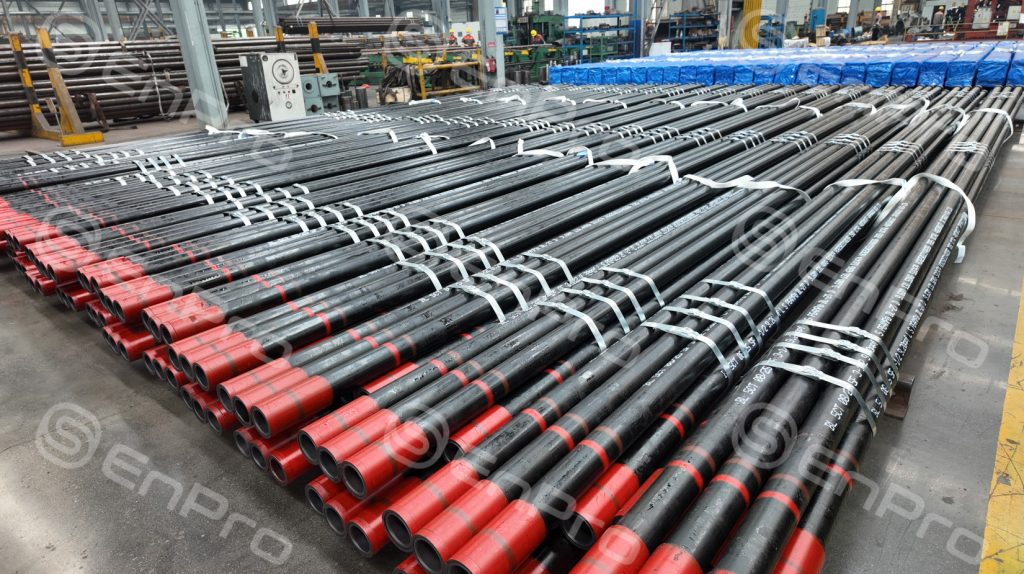
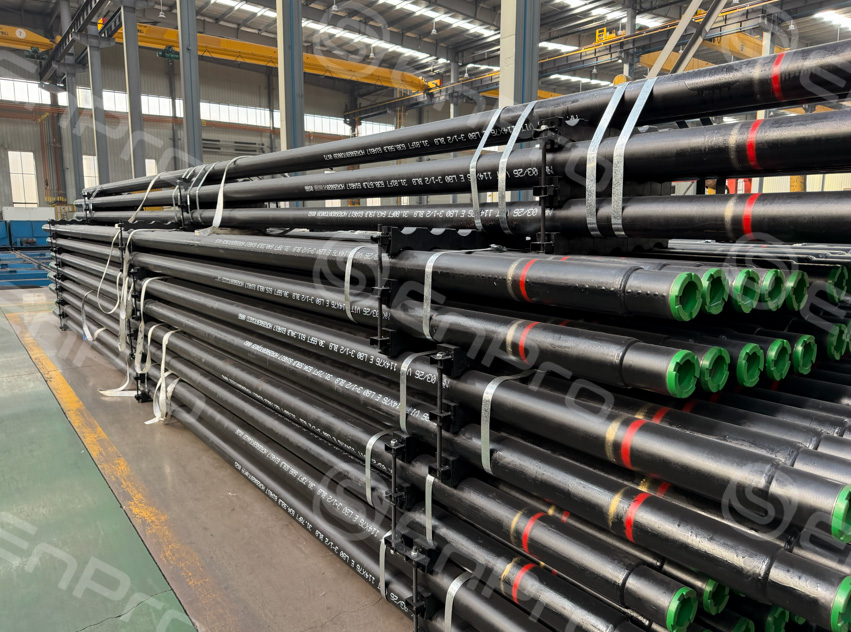
At Enpro Pipe, we pay close attention to the details that often create problems after an OCTG order leaves the mill. Different grades, wall weights, connections and couplings are identified and grouped clearly, while thread protectors, bundle marks and packing information are prepared to make receiving and site handling easier.
For project orders containing several casing and tubing specifications, we can organize material certificates, heat numbers, inspection records and packing lists by item or shipment batch. End preparation, coupling matching and shipment arrangement are also coordinated before dispatch, helping the buyer check the material quickly and move it into storage, inspection or field use with fewer identification issues.
Q1: Why can two API 5CT casing pipes with the same OD and grade have different prices?
A1: The same OD and grade can be supplied in different nominal weights, wall thicknesses and connections, which change steel consumption, internal diameter, drift diameter and pipe performance. Quotations should therefore be compared using the complete OD × weight/wall × grade × connection × length specification.
Q2: Can N80 Type 1 and N80Q be treated as the same material when purchasing OCTG?
A2: They belong to the same N80 strength grade but have different material conditions; API marking distinguishes N80 Type 1 as N1 and N80Q as NQ. When N80Q is specified, the PO, pipe marking and material certificate should identify that condition clearly.
Q3: Can the coupling grade or heat treatment differ from the casing or tubing pipe body?
A3: API 5CT provides for alternative coupling grades or heat-treatment conditions by agreement. The coupling specification should therefore be confirmed together with the pipe grade and connection so the supplied assembly matches the project requirement.
Q4: Why should drift diameter be checked before ordering OCTG casing or tubing?
A4: Drift diameter represents the minimum internal clearance that the specified mandrel must pass through. Pipes with the same OD can have different wall thicknesses and drift diameters, so the required clearance should be checked against packers, pumps, plugs and other downhole tools before the final size and weight are released for purchase. API 5CT provides drift dimensions by pipe size and mass.
Q5: What should buyers verify when ordering premium connection casing or tubing?
A5: Confirm the exact proprietary connection, qualification basis, make-up procedure and required inspection records. API 5B covers standard API casing and tubing threads, while proprietary connections require their own defined geometry and performance basis; API also maintains dedicated procedures for testing casing and tubing connection performance.