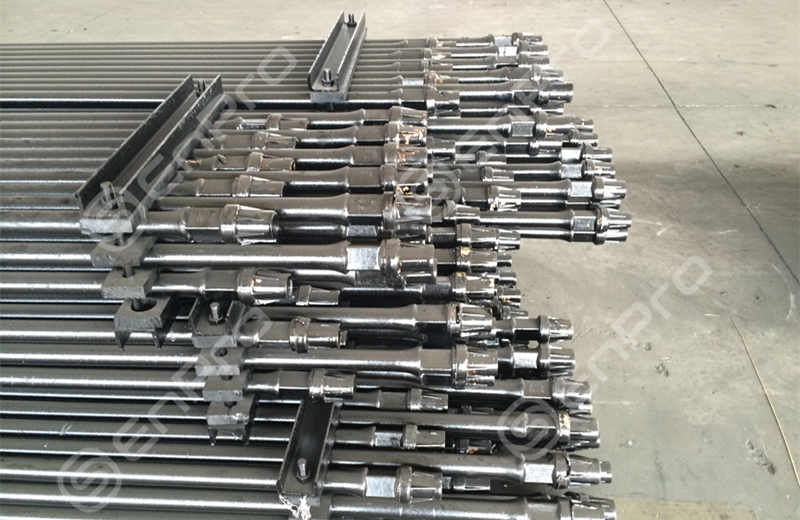

API 11B sucker rod transfers the reciprocating movement from the surface pumping unit to the downhole pump through the rod string. Each rod joint operates under repeated tensile loading, compression, bending, thread stress and corrosion exposure during pumping cycles, making the selection of rod grade, diameter, connection, coupling type and manufacturing quality directly related to rod-string reliability.
Sucker rods are manufactured as a complete connection system consisting of the steel rod body, upset ends, threaded pin connection and coupling. API 11B defines the requirements for sucker rods, pony rods, polished rods, couplings and related components used in rod pumping systems. The commonly specified grades include Grade C, Grade D, Grade K and Grade KD, with different strength and corrosion-resistance characteristics for various production conditions.

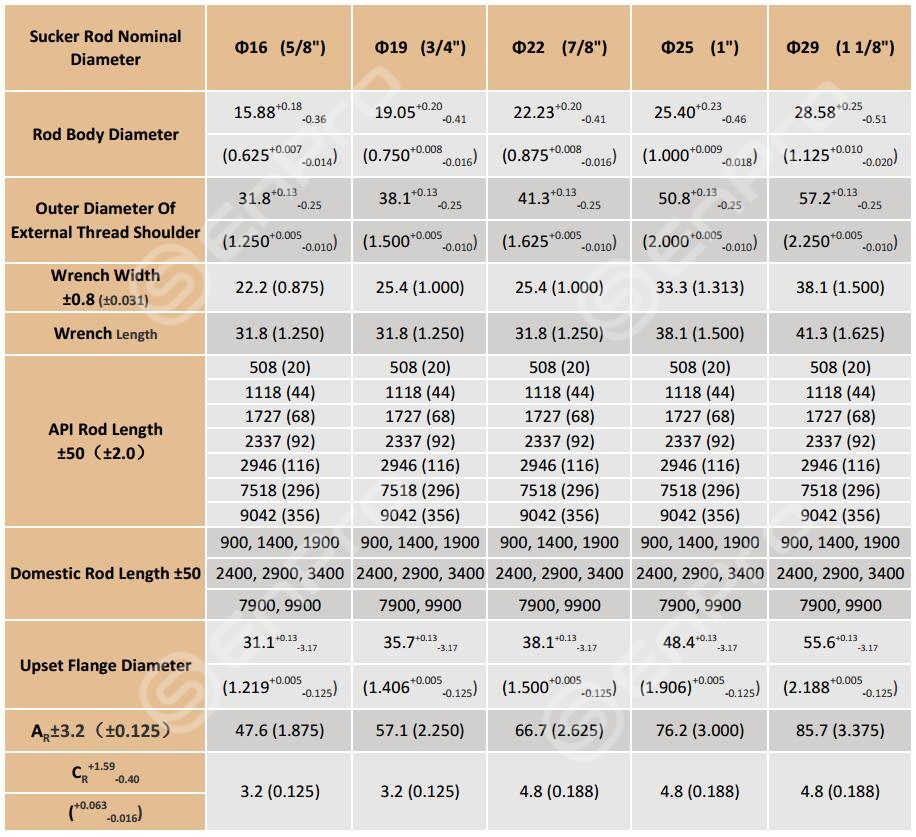
Sucker rod size affects the load capacity, rod-string weight and available clearance inside the tubing. API 11B commonly covers several nominal diameters, with selection depending on pump depth, tubing configuration and expected operating loads.
| Rod Size | Nominal Diameter |
|---|---|
| 5/8 in. | 15.9 mm |
| 3/4 in. | 19.1 mm |
| 7/8 in. | 22.2 mm |
| 1 in. | 25.4 mm |
| 1 1/8 in. | 28.6 mm |
A complete sucker rod specification normally combines the rod size with the grade, length, thread and coupling configuration. These parameters work together to determine the mechanical performance and compatibility of the rod string.
| Specification Item | Function |
|---|---|
| Rod Diameter | Determines cross-sectional area and tensile load capacity |
| Grade | Defines mechanical strength and material characteristics |
| Length | Determines the overall rod-string configuration |
| Thread Type | Controls connection strength and make-up performance |
| Coupling Type | Influences wear resistance and tubing clearance |
The final rod-string configuration should match the pump depth, tubing size, fluid load and operating conditions to maintain reliable load transfer during pumping cycles.
API Spec 11B defines the requirements for sucker rods and related rod-string components used in beam pumping systems. The specification covers the key factors that affect product performance, including dimensions, mechanical properties, material requirements, thread design, inspection and acceptance criteria.
| Item | API 11B Scope |
|---|---|
| Product | Sucker rods, pony rods, polished rods and couplings |
| Common Rod Sizes | 5/8 in., 3/4 in., 7/8 in., 1 in., 1 1/8 in. |
| Common Grades | C, D, K, KD |
| Main Components | Rod body, upset end, pin thread and coupling |
| Connection Type | API sucker rod thread connection |
| Main Applications | Beam pumping and rod-lift production systems |
A sucker rod specification is normally confirmed according to the actual well conditions and rod-string requirements. Key factors include well depth, pump load, corrosion exposure, tubing clearance, pumping frequency and expected fatigue cycles. Grade selection affects tensile capacity, while connection design, coupling performance and operating conditions also influence the service life of the complete rod string.
Sucker rod grades define the combination of strength, toughness and corrosion resistance required for different rod pumping conditions. API 11B commonly covers Grade C, Grade D, Grade K and Grade KD sucker rods, with each grade offering different mechanical characteristics for conventional wells, higher-load applications and corrosive production environments.
| Grade | Material Characteristics | Typical Application |
|---|---|---|
| Grade C | Carbon steel grade with general service performance and moderate strength | Conventional rod pumping wells |
| Grade D | Higher-strength carbon steel grade for increased tensile loading capacity | Higher-load rod strings |
| Grade K | Alloy steel grade with improved corrosion resistance compared with carbon steel grades | Wells with corrosive production fluids |
| Grade KD | Alloy steel grade combining higher strength with improved corrosion resistance | High-load and corrosive production environments |
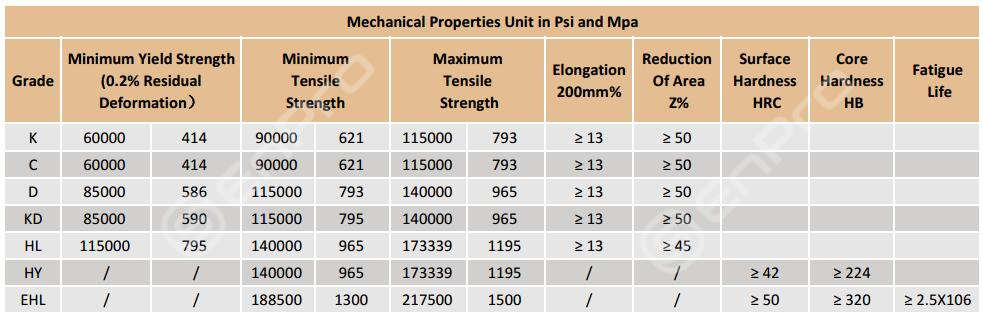
Mechanical performance varies between sucker rod grades and is controlled through material selection and heat treatment. The main strength requirements for common API 11B grades are listed below.
| Grade | Minimum Yield Strength | Minimum Tensile Strength | Elongation |
|---|---|---|---|
| C | 414 MPa (60 ksi) | 621 MPa (90 ksi) | ≥13% |
| D | 586 MPa (85 ksi) | 793 MPa (115 ksi) | ≥13% |
| K | 414 MPa (60 ksi) | 621 MPa (90 ksi) | ≥13% |
| KD | 590 MPa (85.6 ksi) | 795 MPa (115.3 ksi) | ≥13% |
Grade selection depends on the complete operating condition of the rod string. Deeper wells with higher suspended loads generally require higher-strength grades, while corrosive fluids and high-cycle pumping conditions require additional consideration of alloy composition, fatigue resistance and connection performance.
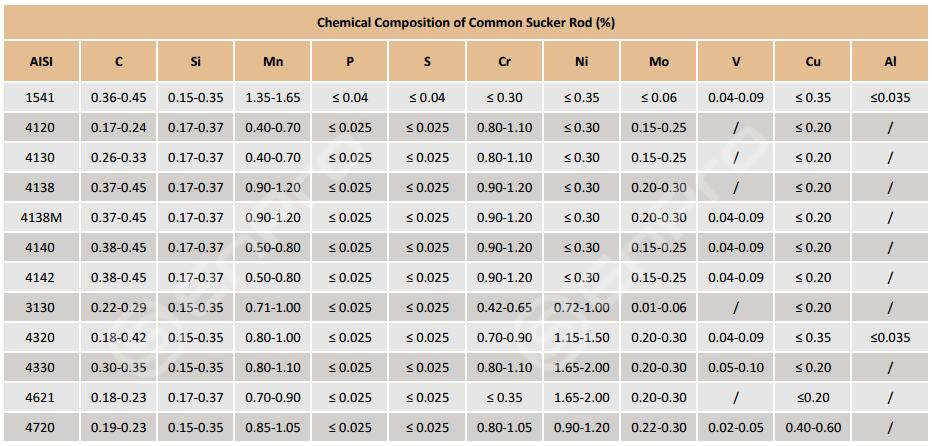
Sucker rods are manufactured from alloy steels selected to provide the required balance of strength, toughness and fatigue resistance after heat treatment. Common steel materials include 4138, 4140, 4142, 4330M and related alloy grades, with chemical composition controlled according to the required mechanical properties and service conditions.

The final mechanical performance is achieved through controlled alloy composition and heat treatment. Material selection is coordinated with the required sucker rod grade, loading condition and corrosion environment.
A sucker rod consists of several functional sections that work together to transfer surface movement to the downhole pump.
| Component | Function |
|---|---|
| Rod Body | Carries the main tensile load along the rod string |
| Upset End | Provides increased material thickness for thread machining |
| Pin Thread | Transfers axial load through the connection |
| Coupling | Joins individual rod sections into the complete string |
The upset end is manufactured with increased cross-sectional material compared with the rod body. This provides sufficient thread engagement area and reduces stress concentration around the connection area, where repeated loading occurs during every pumping cycle.
The coupling transfers load between adjacent rods and protects the threaded connection. Coupling selection is particularly important in deviated wells where tubing contact and wear become more significant.

Couplings connect individual sucker rod joints and maintain the mechanical continuity of the rod string.
| Coupling Type | Characteristics |
|---|---|
| Full-Size Coupling | Standard outside diameter for conventional wells |
| Slim-Hole Coupling | Reduced outside diameter for limited-clearance tubing applications |
| Spray Metal Coupling | Surface coating improves wear resistance and service life |
Slim-hole couplings reduce external diameter and help increase clearance between the rod string and tubing. They are commonly considered where tubing diameter, deviation or friction limits the available operating space.
Spray metal couplings improve surface wear resistance by adding a protective layer to the coupling surface, reducing damage caused by repeated tubing contact.
Sucker rod manufacturing starts with alloy steel bars selected according to the required grade and mechanical performance. The production process controls the rod body strength, upset-end geometry, thread accuracy and surface condition, which directly affect the load transfer capability and service life of the rod string.
A typical manufacturing route includes:
Steel bar inspection → hot upsetting → heat treatment → straightening → thread machining → surface treatment → coupling assembly → final inspection
The steel bar is first checked for chemical composition, dimensions and material traceability before forming. During hot upsetting, both rod ends are locally enlarged to provide sufficient material for thread machining and improve the load-bearing area of the connection. The upset section must maintain a smooth transition to reduce stress concentration during repeated pumping cycles.
After upsetting, the rod undergoes heat treatment to achieve the required combination of yield strength, tensile strength, hardness and toughness for the selected API 11B grade. Controlled heating and cooling conditions are important because inconsistent treatment can affect fatigue performance and mechanical uniformity along the rod length.
The threaded connection is then machined according to the specified sucker rod thread requirements. Thread profile, pitch accuracy, taper, surface finish and gauge inspection directly influence make-up performance, connection strength and fatigue resistance. Proper thread control is especially important because the connection transfers the repeated tensile and compressive loads generated during pumping operation.
Before shipment, finished sucker rods are inspected for dimensions, straightness, mechanical properties, thread condition and surface quality. Material identification and inspection records are maintained to ensure each rod batch can be traced back to its production and test data.
Sucker rods are used in rod pumping systems to transfer the reciprocating motion of the surface pumping unit to the downhole pump. During operation, the rod string is subjected to continuous tensile loading from the suspended rod weight and fluid column, while the lower section experiences additional bending, compression and tubing contact forces, especially in deeper or deviated wells.
For conventional vertical wells, common API 11B sucker rods such as 5/8 in., 3/4 in. and 7/8 in. sizes are selected according to pump depth, fluid load and required lifting capacity. As well depth increases, the total rod-string weight increases significantly, requiring higher-strength grades such as Grade D or KD to provide higher tensile capacity. API 11B Grade D and KD sucker rods typically provide minimum yield strengths around 586 MPa (85 ksi), compared with approximately 414 MPa (60 ksi) for Grade C and K.
In corrosive production environments containing CO₂, H₂S or high-water-cut fluids, alloy grades such as K and KD are commonly considered because alloying elements improve resistance to corrosion-related damage. Material selection must also consider the actual operating environment, as corrosion fatigue can reduce rod life even when the nominal tensile load remains within the material strength range.
High-cycle pumping applications require additional attention to fatigue resistance and connection performance. A sucker rod string may experience hundreds of thousands to millions of loading cycles during service, making thread quality, coupling design and surface condition critical factors. Thread damage or poor connection make-up can become the limiting factor before the rod body reaches its theoretical strength.
In deviated wells, tubing contact increases wear on the coupling and rod body. Slim-hole or wear-resistant coupling designs may be selected where tubing clearance and contact conditions require additional control. The final sucker rod configuration is normally determined by the combination of rod diameter, grade, coupling type, pump depth, production fluid characteristics and expected operating cycles.

Enpro Pipe manages sucker rod supply with a focus on material consistency, connection reliability and shipment traceability. Each production batch is controlled from raw material identification through final inspection, ensuring that the supplied rods match the specified grade, diameter, length, thread configuration and coupling requirements.
Before delivery, sucker rods are verified through key inspection stages including chemical analysis, tensile testing, hardness testing, dimensional inspection, thread gauging and surface condition checks. Inspection records are organized with product identification to support material traceability and receiving verification.
For orders involving multiple grades, sizes or coupling configurations, Enpro Pipe maintains clear separation of heat numbers, inspection documents, product markings and packing information. This helps reduce specification mix-up risks and allows each rod batch to be efficiently verified before field installation.
A1: Sucker rod strength should be evaluated based on the complete rod-string loading condition, including rod weight, fluid load, pumping depth, acceleration effects and dynamic loading. The selected grade must provide sufficient tensile capacity while maintaining connection and fatigue performance under repeated pumping cycles.
A2: Service performance can vary due to differences in steel quality, heat-treatment control, straightness, thread accuracy, surface condition and coupling matching. The rod body strength alone does not determine the operating life of the complete rod string.
A3: The rod body carries the main axial load, while the threaded connection transfers load between individual rod joints. Connection performance depends on thread geometry, machining accuracy, make-up condition and coupling compatibility, which can become the limiting factor in fatigue service.
A4: Alloy grades such as K and KD are considered when the production environment involves higher corrosion risk, including wells with CO₂, H₂S exposure or high water content. Selection should be based on the actual corrosion mechanism and operating conditions rather than grade strength alone.
A5: Acceptance documentation should link each batch to its material identification, chemical analysis, tensile test results, hardness results, dimensional inspection and thread inspection records. Complete traceability helps verify that the delivered rods match the ordered grade and specification.